Projects / PhysTwin
PhysTwin
2026
Turns a real video into a metric 3D trajectory, fits a Newton/Warp scene, then resimulates it under different gravity.
- Python
- SAM2
- Depth Anything 3
- NVIDIA Newton
- Warp
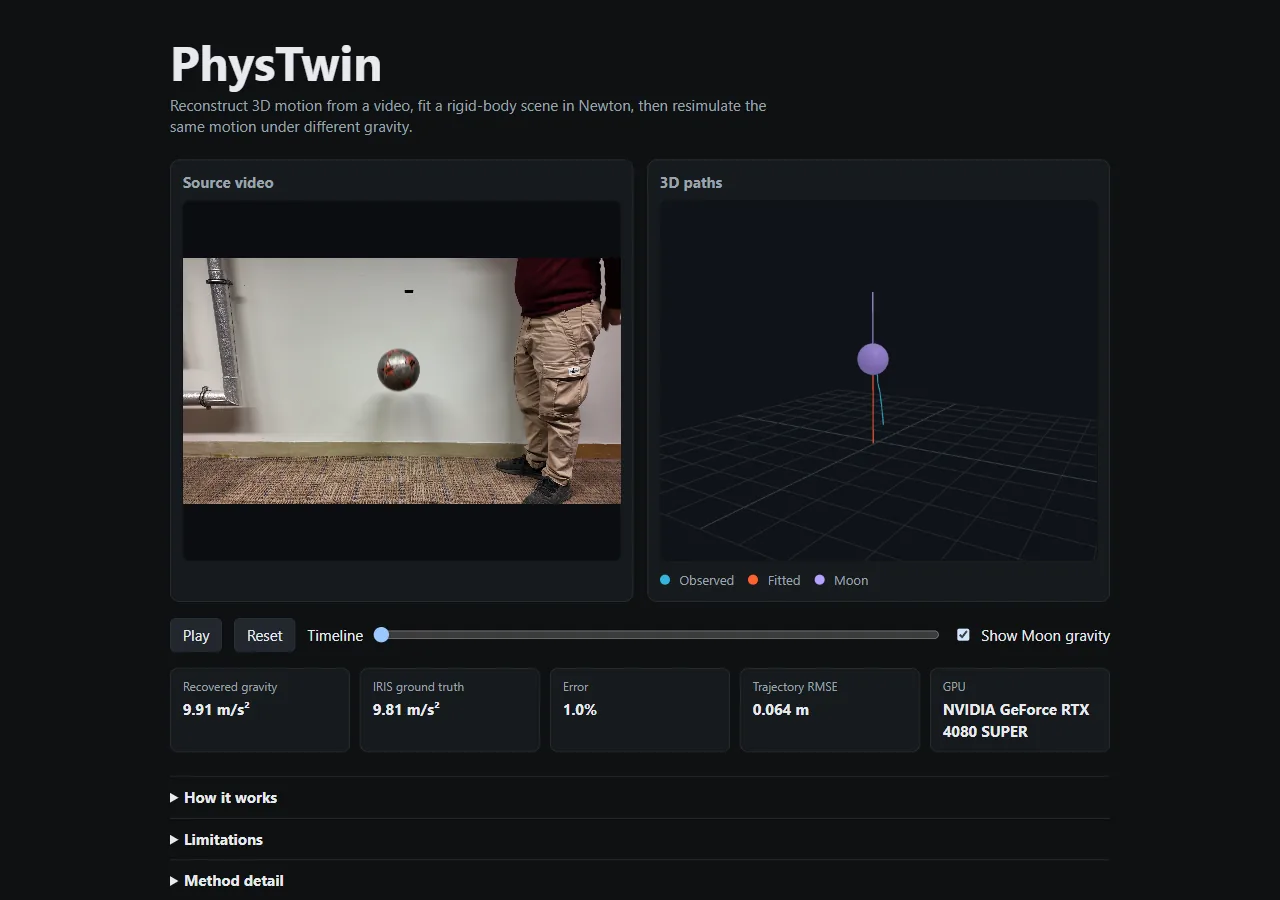
PhysTwin turns one real video clip into a metric 3D motion observation, fits an executable rigid-body scene with NVIDIA Newton / Warp on CUDA, then resimulates that scene under different gravity.
Video
  → SAM2 tracking
  → DA3 camera
  → known-radius sphere reconstruction
  → PhysicalMotionObservation
  → Newton + Warp inverse fit
  → PhysicalScene
  → counterfactual rollout
The current evaluation is IRIS Falling_ball/big/01.mp4, 1.40-1.90 s, 16 frames. Scale comes from the measured ball radius, 0.11 m. DA3 supplies camera intrinsics and poses. DA3 depth is not used as metric moving-ball depth.
What I built
- SAM2 mask tracking from a click prompt.
- Camera
K/ pose reconstruction through Depth Anything 3. - Metric lift from a known 0.11 m radius.
- Project-owned contracts: observation, physical scene, and simulated world state.
- Newton 1.5.1 / Warp 1.16 simulator-in-the-loop gravity fit on CUDA.
- Moon-gravity counterfactual from the fitted scene (1.62 m/s²).
- React / Three.js viewer for committed artifacts.
The optimizer search is CPU/NumPy. Each objective evaluation invokes the GPU simulator. The repo does not include custom @wp.kernel CUDA kernels. C++20 V1 is retained image-space CTest evidence. The IRIS gravity result uses Newton/Warp.
Measured result
IRIS falling-ball clip, NVIDIA GeForce RTX 4080 SUPER:
- Recovered gravity: 9.91 m/s² versus IRIS 9.81 m/s² (1.0% error)
- Trajectory RMSE: 0.064 m (normalized 0.107)
- 88 Newton evaluations, 18.6 s committed fit
- Evaluation gate: acceptable, not ideal (
nRMSE > 0.10) - IRIS gravity was unread during the fit
The purple Moon path is the same fitted drop with gravity set to 1.62 m/s². It was not observed.
Limits
- Monocular reconstruction needs a measured length or radius.
- Physics is one rigid sphere plus gravity. No contact, drag, or articulated humans.
- Counterfactuals are simulated hypotheses, not observations.
- Evaluated on one IRIS falling-ball clip.
- An earlier IRIS pendulum experiment completed a Newton run and failed as physics (RMSE 0.616 m). That residual is kept in the repo.
Figures